
Empowering Professionals at Every Stage
Portrait offers strategic expertise to help you make informed decisions and achieve long-term success.
Book Intro CallIf you run a med spa that purchases or discusses GLP-1 products in 2026, double-check every vendor, record, and public statement. The FDA has increased warning-letter activity, proposed compounded tirzepatide restrictions, and focused on telehealth and med spa clinics.
Do not assume a process that worked in 2024 still meets current requirements. Review pharmacy credentials, ordering records, marketing language, and state rules. This guide explains what changed, what documentation to request, and what to update before your next order.
Tirzepatide is the active ingredient in the FDA-approved brand drugs Mounjaro and Zepbound. Compounded tirzepatide is not FDA-approved. Because the shortage ended, compounding has less flexibility. Clinics should reassess sourcing, prescribing controls, recordkeeping, and patient-facing language with counsel and pharmacy partners.
2026 FDA Compounded Tirzepatide Rules: What Med Spas Need to Know
Mounjaro and Zepbound are FDA-approved products made by Eli Lilly. Compounded tirzepatide is a separate, non-FDA-approved preparation. Rules affecting copies tightened after the 2023-2024 shortage, so clinics should not rely on old vendor assurances.
This article is for education. It is not a replacement for legal or medical advice. Talk to your healthcare attorney, medical director, pharmacy partners, and state board about your clinic's specific situation before changing sourcing or operations.
The Core Issue: Shortage Status Changed Everything
FDA drug-shortage status matters because it affects when pharmacies may legally compound copies of approved products. When a qualifying shortage ends, the shortage-based enforcement policies and exceptions do not simply continue.
The FDA decided on October 2, 2024, that the tirzepatide shortage was over, and reaffirmed that decision in December 2024. 503A pharmacies lost the relevant enforcement discretion on February 18, 2025. 503B outsourcing facilities lost theirs on March 19, 2025. Orders placed after those dates need a documented legal basis that the clinic, prescriber, and dispensing pharmacy can support.
Why This Matters for Aesthetic and Wellness Clinics
Many med spas built recurring programs while the shortage was active. Membership billing, monthly fulfillment, and telehealth created fast-moving purchasing workflows that now need regulatory review.
Rebuild the program around four controls:
- How you verify and source each product
- How authorized prescribers and pharmacies document each order
- How you communicate FDA approval status and supplier identity
- How you retain invoices, prescriptions, lot records, and shipping data
This affects intake, marketing, vendor agreements, receiving, inventory, and audit readiness. For related details, review our 2026 GLP-1 compliance update.
What the FDA Has Said About Compounded Tirzepatide
The FDA says copies of FDA-approved drugs may be compounded only when legal requirements are met. Neither tirzepatide nor semaglutide is on the 503B Bulks List or shortage list right now. A supplier should identify the legal basis for each order type.
On April 30, 2026, the FDA said it wants to exclude semaglutide, tirzepatide, and liraglutide from the 503B Bulks List. The agency stated that it found no clinical need for outsourcing facilities to compound these substances from bulk drug substances. The public comment period runs until June 29, 2026. Clinics should track the final action and ask suppliers how any change will affect available inventory, order acceptance, and documentation.
Compounding Is Not the Same as FDA Approval
This distinction belongs in staff training, vendor files, and patient-facing materials. Compounded drugs are not FDA-approved, even when a licensed pharmacy makes them. FDA approval includes agency review of safety, effectiveness, labeling, and quality. Compounded products do not undergo that approval review.
The FDA stated: "Compounded drug products are not FDA-approved. Your claims imply that your products have been FDA-approved or otherwise evaluated for safety and effectiveness when they have not." That language appeared in the 30 warning letters sent to telehealth companies in February 2026. Use the exact approval status in marketing and avoid language that borrows claims from an approved brand.
Personalized Does Not Automatically Mean Allowed
Some pharmacies add vitamins or other ingredients and describe a preparation as personalized. That label alone does not establish that compounding is permitted. As of fall 2025, more than 80% of compounded products in the reviewed category mixed tirzepatide or semaglutide with B vitamins or amino acids.
The FDA's position is that adding an ingredient does not by itself make a copy meaningfully different. The prescriber and pharmacy need documentation supporting the specific legal basis for a patient-specific preparation.
A March 2026 study reported a tirzepatide-B12 adduct in mass-compounded tirzepatide with B12 that is not present in FDA-approved tirzepatide. Ask a supplier for formulation records, testing methods, certificates of analysis, and its review of combination-product changes.
Top Compliance and Sourcing Risks for Med Spas
Risk extends beyond the product itself. It appears in ads, purchasing workflows, records, receiving checks, and staff scripts. Most clinics should review the following areas first.
Risk 1: Using Vendors With Poor Documentation
- Verify every supplier before the first order and at renewal.
- Confirm pharmacy licenses, 503A or 503B status, and permissions in every relevant state.
- Confirm when patient-specific prescriptions are required and how the pharmacy validates them.
- Request certificates of analysis and define which documents accompany each shipment.
- Track lot numbers, expiration dates, storage requirements, receiving conditions, and the final disposition of every unit.
The FDA has identified counterfeit compounded tirzepatide in the US market, including labels that name pharmacies that do not exist. Verify the pharmacy through official licensing databases, match invoice and shipping details, inspect tamper evidence, and quarantine any shipment with inconsistent records.
Risk 2: Overblown Marketing
The FDA's 2026 warnings called out language such as:
- "same active ingredient as Mounjaro"
- "generic Zepbound"
- Statements that attribute an approved product's FDA review to a compounded product
Audit your website, Instagram, ads, landing pages, texts, and scripts. Remove wording that calls a compounded product FDA-approved, identical to a brand, or evaluated under a brand's approval. Keep approval status and supplier type clear.
Risk 3: Weak Oversight and Documentation
Every purchase and prescription should connect to a complete, reviewable record. At minimum, keep:
- The authorizing prescriber's identity, credentials, and applicable state licenses
- The dispensing pharmacy's license verification, facility status, and state permissions
- The prescription, informed-consent record, invoice, shipment record, and product identifiers
State boards may request records connecting purchasing, prescribing, receipt, storage, and disposition. Set a retention schedule, assign a document owner, and test retrieval. For broader context, see our GLP-1 practitioner guide.
Risk 4: Messy Inventory and Dispensing
- Reconcile what you ordered, received, stored, transferred, returned, and disposed of
- Monitor expiration dates, refrigerator temperatures, reorder timing, shipping excursions, and chain of custody
- For 503A pharmacy purchases, retain the patient-specific prescription required for each order
- Quarantine stock when records, labels, seals, quantities, or temperature data do not match
How Med Spas Should Audit Their Tirzepatide Program in 2026
Treat this as a sourcing and compliance review. Check each area before approving a new vendor, renewing a contract, or accepting another shipment.
Step 1: Vet Your Vendors
Check primary-source licenses, state permissions, facility status, recall history, documentation, and shipping controls. Confirm that the order model meets current requirements. If a material point cannot be verified, pause ordering and document it.
Step 2: Update Patient-Facing Language
Review your website, booking forms, ads, social media, intake forms, and consent materials. State whether a product is FDA-approved, identify compounded products accurately, and avoid brand equivalence or language drawn from approved labeling. Have qualified counsel review final copy and keep the approved version with its review date.
Step 3: Train Front Desk and Coordinators
- Non-clinical staff are often the first point of contact for product and fulfillment questions.
- Provide scripts covering approval status, supplier type, prices, order timing, refills, and escalation paths.
- Route medical questions to authorized clinical staff.
- Do not let non-clinical staff make product comparisons, promises, or therapeutic claims.
Step 4: Document Everything
- Retain supplier verification, contracts, licenses, invoices, and ordering authority
- Connect prescriptions and consent records to shipment and product identifiers
- Record receipt, storage, transfers, returns, recalls, and final disposition
Complete records make internal reviews and regulator requests easier to handle.
How to Talk to Patients About Compounded Tirzepatide
Online information and changing telehealth programs can create confusion. Use plain, factual language about FDA approval status, the dispensing pharmacy, price, fulfillment, and whom to contact with clinical questions.
Be Simple and Build Trust
Explain that your clinic follows current state and federal requirements and verifies its purchasing channels. Identify the pharmacy, distinguish an FDA-approved brand from a compounded preparation, and explain how patients can verify pharmacy credentials.
Give patients the pharmacy name, contact route, approval status, fulfillment steps, pharmacy-supplied storage instructions, and a process for reporting packaging or delivery problems.
Do Not Make Price the Big Focus
Patients care about price, but lower cost must not be presented as proof that a compounded product is equivalent to an FDA-approved brand. Use a written quote that separates product, pharmacy, shipping, clinic, software, and recurring service charges so patients can compare the actual total cost.
Mind State Rules: Do Not Stop at Federal Guidance
FDA requirements are only one layer. State medical, nursing, and pharmacy boards, along with telehealth and corporate-practice rules, affect who may prescribe, who may order, where products may be shipped, and whether a clinic may store or dispense them.
Boards in New York, California, Texas, and Florida have disciplined telehealth-only prescribers in this category. Read our 2026 state regulation update for changes involving telehealth, documentation, and medical-director involvement in your state.
Smart Compliance Questions to Ask Your Team or Attorney
- Who can legally prescribe products in this category in our state?
- What does state law require for a valid telehealth relationship and prescription?
- May we store or dispense these products, or must the pharmacy ship directly?
- What medical-director role and written agreements are required?
- How long must we retain clinic, purchase, shipping, and inventory records?
- Which marketing and patient-facing materials require legal review?
Actions That Protect Your Margins and License
Do not build a 2026 purchasing plan around a regulatory loophole. Build a controlled program with verified suppliers, clear costs, consistent receiving checks, and complete documentation.
Standardize Your GLP-1 Procurement Process
Document the full purchasing workflow:
- Supplier intake
- License verification
- Contract and legal review
- Ordering authorization
- Purchase order approval
- Shipment and temperature-data review
- Receiving and quarantine checks
- Inventory reconciliation
- Recall and incident reporting
- Returns and documented disposal
Assign an owner and required evidence to every step. Inconsistent purchasing and receiving workflows create gaps that are difficult to reconstruct during an audit.
Watch Costs and Profitability
Full cost includes supplies, provider time, labs, follow-up operations, software, no-shows, storage, shipping, and marketing. Track COGS, invoice changes, freight, waste, expiration, credits, and retention. Do not base forecasts on continued access to a compounded product when shortage status or enforcement policy can change. Model supplier-transition scenarios separately.
Use Software and EHR to Stay Organized
Use your EHR and inventory system to connect prescriptions, consent records, purchase orders, lot data, refrigerator logs, and recall notices. Automated reminders can flag license renewals, expiring stock, missing shipment documents, and unresolved quarantines. Test exports regularly so records are usable outside the software during an audit.
How Portrait Makes Running a Med Spa Smoother
Portrait's Marketplace brings wellness products, injectables, devices, and skincare into one purchasing experience. Clinics can access savings of up to 60% on select products, track inventory, set order reminders, and receive rebate credits for future eligible orders. Portrait's Marketplace is additive to existing manufacturer-representative relationships and does not replace them.
Portrait also brings EHR, scheduling, payments, operational tools, medical-director matching, good faith exams, and marketing support into one system. Centralized records can make it easier to match purchasing activity with clinic operations and identify missing documentation.
There is no revenue share. If you are operating or growing a medical weight loss program, Portrait provides tools for purchasing, inventory visibility, documentation, and day-to-day administration.
Build a 2026 GLP-1 Program That Passes Inspection
The FDA is applying stricter scrutiny, and compounded tirzepatide rules require close attention. Review supplier status, pharmacy licenses, contracts, invoices, shipping records, marketing language, and inventory controls now.
Confirm federal and state requirements with qualified advisers. Use systems that provide full visibility from vendor approval through receiving, storage, reconciliation, and document retention. A tested audit trail is easier to defend than records assembled after an inspection or warning letter arrives.
If you need operational support, Portrait is ready to help. Book an intro call to see how Portrait can support your practice.
Related reading
One Platform.
Everything You Need.
Everything You Need.
Portrait combines the technology, support, and savings to run and scale your modern medical wellness business.
Book Intro Call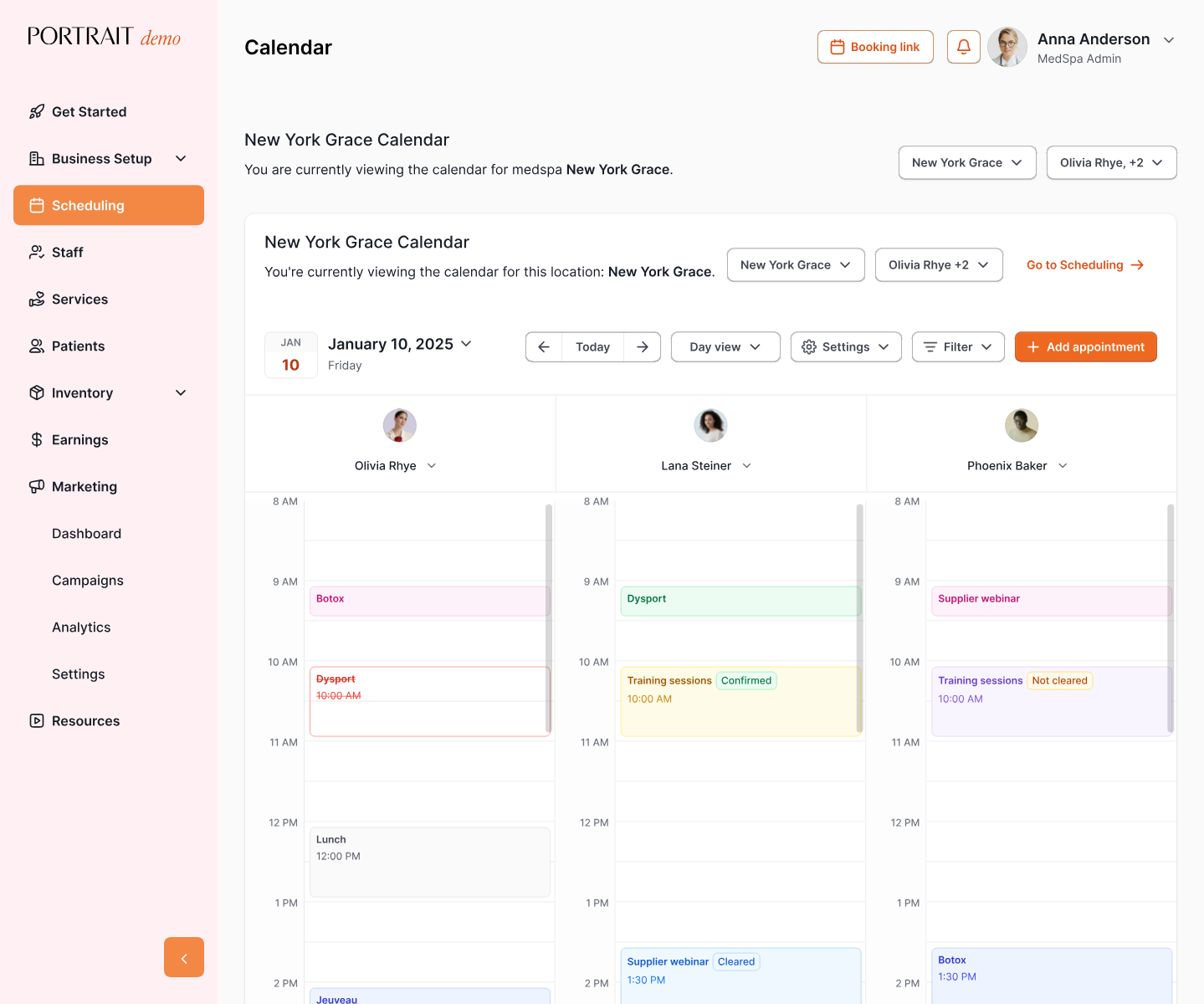


Stay Connected with Portrait Care
Subscribe to our email list and receive the latest insights, updates, and exclusive content delivered straight to your inbox.